

“At the still point of the turning world
….there the dance is” – T.S. Eliot, Four Quartets: Burnt Norton
Walking through the park recently, I placed myself in the present moment. I was rewarded with birds.
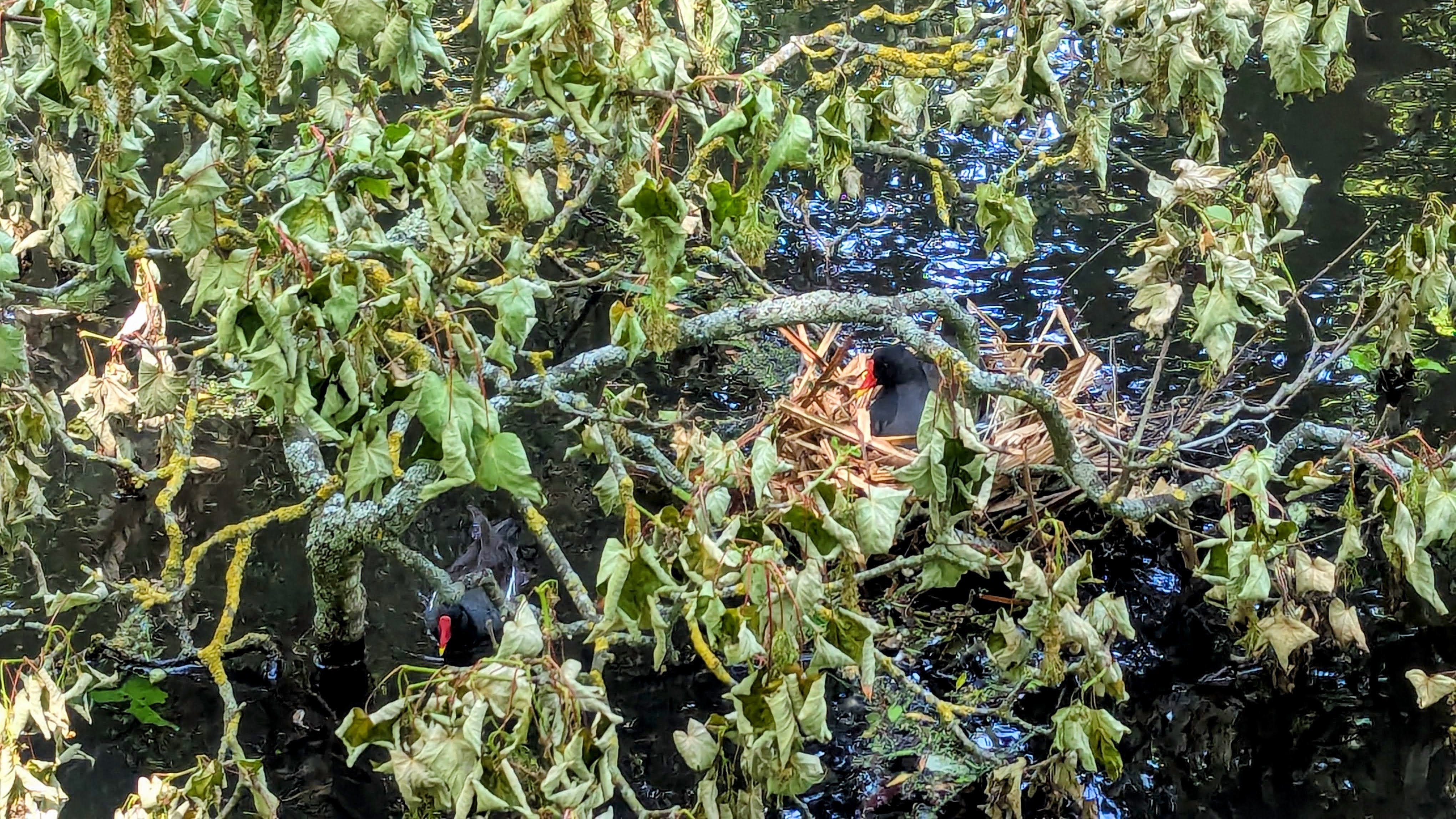
A fallen branch had lodged itself in the middle of the stream. Hidden beneath it sat a moorhen on her nest.
Her partner paddled towards her, bringing reeds. She wove them into place.
I stood, watching, for half-an-hour. She stood, to re-arrange her feathers, and I spotted six grey-green eggs in the nest.
Passers by joined me, asked what I was looking at. I taught moorhen facts to an American woman; I showed the nest to nearby duck-feeding children; I made new friends.
Later that day, on another long walk, I took my earbuds out so that I could take a phone call1 from a prodigious poet warlock fabulous friend.
Ninety minutes later, the call ended, and one earbud had gone missing. I invoked Saint Anthony and retraced my steps.
No luck. I retraced them again.
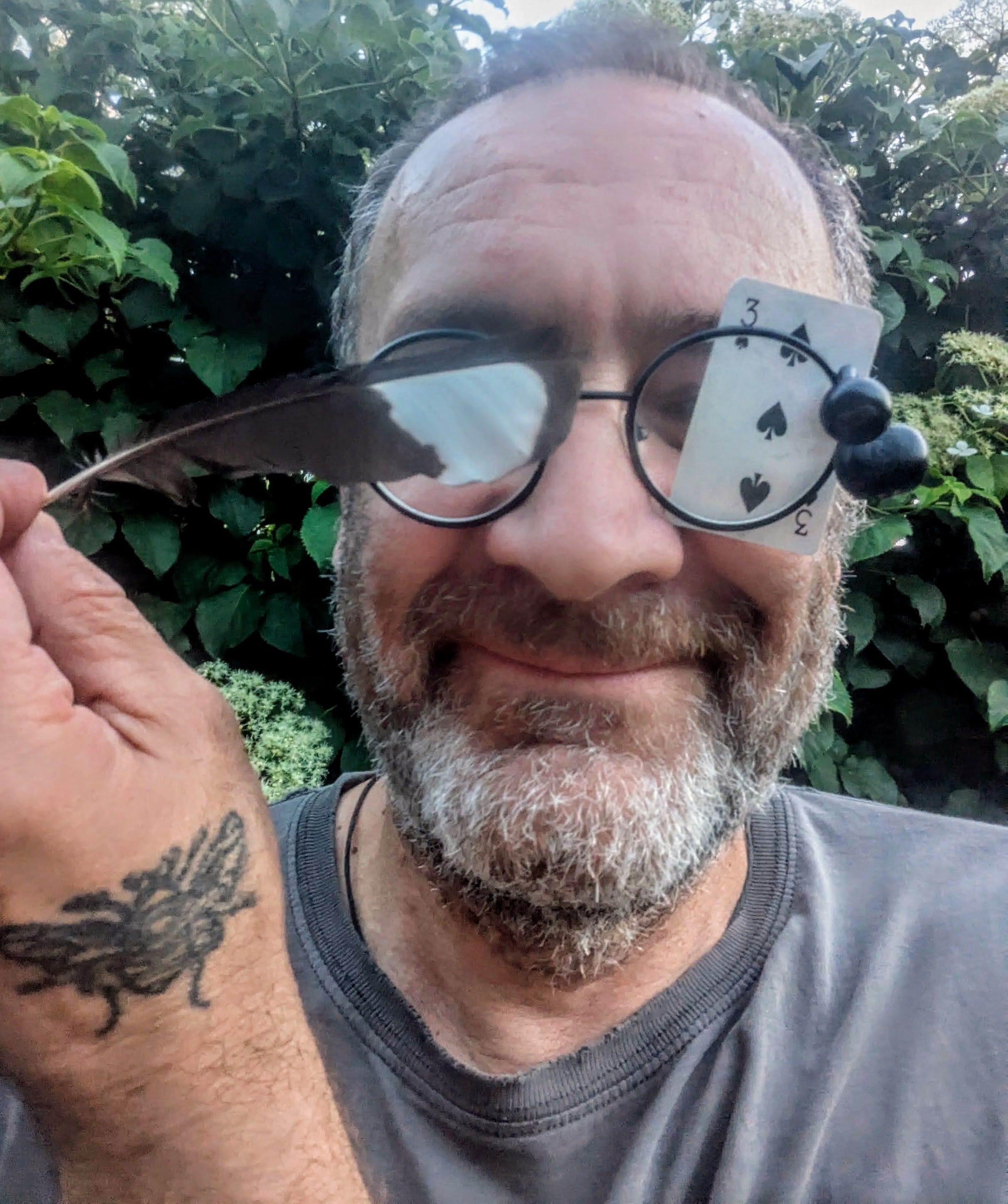
I’d lost hope of finding the earbud. But the search rewarded me with a magpie feather, a three of spades2, and a five-penny piece.
Then I found the earbud, underneath the bananas in Tesco. Thank you, Saint Anthony.
Attention is an odd thing. Like the stylus on a record player, it is the single point of contact between our experience and the all-that-is. It matters where we place it.
Despite 37 years of meditation practice3, I spend most of my time replaying the past or rehearsing the future.
I tell others that I suffer from a “defecit” of attention, because my stylus skips from groove to groove.
The present moment is easy to miss. Yet whenever we return to it, things happen.
Focusing attention on whatever is now present is a form of prayer. It may also be the mechanism by which magick works.
Perhaps the universal consciousness rewards our attention. Perhaps attention simply reveals what is already there. The difference scarcely matters. Magic happens when we pay attention.
So shut down your computer, put down your phone, go outside, and attend to nature. See what happens.
Andy Wilson
Hello to the many new subscribers who arrived here via a recommendation from Andy Wilson’s Traveller in the Evening site.
As many of you will know, and as heralded in his final post, Andy recently died, just a couple of months after receiving his diagnosis of stage 4 lung cancer.
I first met Andy on a training course for a long-forgotten piece of enterprise software. We bonded over a love of experimental music, in particular the band Faust.
Over the next thirty years we repeatedly lost touch and then found one another again. When we reconnected a few years ago, I was fascinated by the extent to which William Blake and Christianity had come to shape Andy’s life and thinking. We had many conversations about both. At my invitation, Andy joined several online deep-reading sessions with The Eugene Halliday Association, where he made thoughtful and often provocative contributions.
Andy could be stubborn and feisty. Last year, after a minor disagreement, he blocked me on Facebook and we again lost touch.
I am deeply grateful to the mutual friend who told me of Andy’s illness. Andy and I made our peace. And I was able to visit him in his final weeks, and help him with the publishing software he was using to prepare a new book.
I do not yet know whether he completed the book before his death. When I learn more, I will share news here.
Farewell, Andy.
An update on my life
Regular subscribers may have noticed that my last post was over nine months ago. I wrote it on the day I set off on a 500-mile pilgrimage across England, from Cornwall to Norfolk.
The pilgrimage was wonderful. I wish I were still walking.
Life since then has been much harder, often unbearable.
I did not expect ever again to reach the kind of low points which I wrote about in 2024. In fact 2026 has been far worse.
I would like to repeat my plea from that earlier post: please sign up for the Zero Suicide Alliance’s suicide awareness course. You could save a life.
I believe that I am now slowly recovering.
What helps most right now is human contact: messages; conversations; invitations; opportunities to meet new people. All of these matter more than I can easily express.
I am also struggling financially. If you would like to support my work, purchases from the Peakrill bookshop and paid subscriptions to this Substack are greatly appreciated.
A note from the ancestors
The T.S. Eliot quote with which I opened this article has, like the poem that contains it, enriched my life. I return to it often.
I was delighted to discover, while researching the life of my grandpa Harold Sumption, that he too used this line, in an article he wrote for the Quaker magazine Friends Journal in 1972:

Yes, I ought to be able to use the phone with earbuds in, but they don’t pick my voice up very well.
Tarotistically, the 3 of Swords. Apt.
Admittedly pretty shonky and mostly intermittent meditation practice.


